

The Tragedy of Willful Biblical Illiteracy

We live in a generation where people will proudly wear the name of Jesus, yet throw a fit when confronted with the actual words of Jesus. They will wear the cross, use the vocabulary, maybe even occasionally quote inspirational fragments of Scripture out of context as they exhuberently proclaim that God loves everyone, and confidently tell others what Jesus would—or would never—say or do…
But the sad reality is… the Jesus they proclaim looks almost nothing like the Christ revealed in Scripture.
How does this happen?
How do people who publicly profess to be Christians come to enthusiastically embrace ideas, lifestyles, and doctrines that directly contradict the clearest, most basic teachings of the very Savior they claim to follow?
How do people arrive at a place where biblical truth is labeled hateful, calls to repentance is considered judgmental, holiness is decried as legalism, and even the most basic doctrines of historic Christianity are negotiable?
Certainly, there are many contributing factors. But the one that stands out as especially tragic and avoidable:
BIBLICAL ILLITERACY
I’m not writing about the unfortunate ignorance of someone who has never been taught the Scriptures. I’m pointing my “judgemntal finger” at something FAR more troubling.
Willful biblical illiteracy. That is the deliberate neglect of God’s Word by people who claim to belong to the God who gave it.
The Christianity of Convenience
Somewhere along the way, much of what passes for American Christianity became little more than a religious accessory, a cultural identity, family tradition, a Sunday morning appointment when convenient, or a collection of warm fuzzy feelings about God.
Their theology is cobbled together from inspirational memes, popular personalities, pseudo-biblical TV series, political preferences, social media influencers, and whatever their favorite grinning preacher happens to say.
They might even know the lyrics to a hundred Bethel, Hillsong, or Elevation worship songs but they can’t remotely begin to explain the gospel.
They may defend their preferred understanding of Jesus with amazing passion, but they can’t demonstrate that understanding from Scripture.
They have lots of opinions about God, but very little real interest in what God has actually SAID.
Paul warned Timothy that a time would come when people would refuse to endure sound doctrine and instead accumulate teachers who would tell them what their desires wanted to hear (2 Timothy 4:3–4).
Do we not see the issue?
Paul didn’t just warn that false teachers would exist, but that people would want false teachers.
They would prefer comfortable falsehoods and tickling ears over uncomfortable truth.
And that brings us to the very center of the problem: biblical illiteracy isn’t from the lack of opportunity. It is almost always the product of a lack of desire.
A Jesus Made in Our Own Image
One of the most destructive consequences of biblical illiteracy is the promotion of a counterfeit Christ. A false version of Jesus that fits popular culture and is often pictures as a forever-affirming buddy and pal, who demands nothing, condemns nothing, and Who exists mainly to affirm our choices and feelings.
He is loving, we are told (and absolutely, Christ IS love!).
But His love is stripped of holiness. His mercy is separated from justice. His forgiveness divorced from repentance. And His grace becomes blanket permission to remain comfortably enslaved to the very sins from which He came to redeem His people. Indeed, to continue in your acts just makes grace abound all the more… (Romans 6:1)
That is simply is not the Jesus of Scripture, because the same Jesus who welcomed sinners also commanded repentance (Mark 1:15).
The same Jesus who demonstrated extraordinary compassion warned repeatedly of judgment (There is a reason Jesus spoke more of Hell and judgment than Heaven).
The same Jesus who said, “Come to Me,” also said that anyone who would follow Him must deny himself and take up his cross (Luke 9:23).
And the same Jesus who declared His love for His disciples said:
“If you love Me, you will keep My commandments.” — John 14:15
Jesus Christ doesn’t call sinners to clean themselves up so that He might finally love them. He calls sinners to Himself, where salvation is wholly by grace through faith. But the gospel’s work, though the Word of God applied, sanctifies believers (effectively changing them to become more Christ-like).
BUT… the grace that saves does not (and can not) leave a person unchanged.
We are not saved by obedience. We are saved to obedience.
Ephesians 2:8–10 makes both truths absolutely clear.
So, when someone demands that God not only tolerates but celebrates what He has explicitly condemned in the Bible, the problem isn’t just a difference of interpretation. It is an overt attempt to remake God according to human desires.
—->That is idolatry.
A Jesus who never contradicts you, never confronts your sin, and never calls you to repentance is nothing more than a Jesus made in YOUR OWN image.
The Bible So Many Died to Give Us
What a great irony…
In 1536, William Tyndale was strangled then burned at the stake after devoting much of his life to translating the Scriptures into English so ordinary people could read the Word of God.
His life’s work helped lay the foundation for the English Bibles that would follow.
Tyndale understood that ordinary Christians needed access to Scripture—not just religious demands handed down by men claiming authority over them.
Centuries later, anyone who wants one, can have a Bible in English (or one of over a 4,170 languages it has been translated into either in part or in whole). We have study Bibles, audio Bibles, totally free Bible apps, searchable original-language tools, and virtually unlimited access to sermons, commentaries, and theological resources.
At the same time, in several nations around the world, believers still face imprisonment, violence, and severe persecution for possessing, distributing, or sharing the Bible.
Yet here in America, where the Bible is readily available, millions of professing Christians barely open it.
Men and women suffered so that generations after them could have access to God’s Word. We have that access—and often cannot be bothered to read it.
The real telling tragedy is that so many who profess to love Christ demonstrate so little desire to know Him through what He has revealed.
BUT… before we point fingers at the most obvious and visibly rebellious people in our culture, we might ought to look inside our own churches.
There’s plenty of socially respectable, politically conservative, regularly attending church members who are just as biblically illiterate.
Their Bibles gather the same dust. Their understanding of the gospel is just as hollow. And quite possibly, their misplaced confidence in their self-righteousness may be evident.
Sadly, biblical illiteracy isn’t confined to one political party, social movement, generation, or lifestyle.
It is a spiritual crisis that runs straight through the visible church.
Ignorance Is Dangerous. Willful Ignorance Is Rebellion.
We have to discern the difference between those who have not yet been taught and those who refuse to be taught. New believers may understand very little Scripture, but should have a sincere hunger to learn.
And we better not miss that some have been subjected to poor teaching for years, so may hold serious theological errors without really realizing it.
Those people need patient instruction, encouragement, and faithful discipleship.
But there is another, terribly large category.
Those who have been confronted with the Word of God and respond, essentially with, “I don’t care what the Bible says. My God would never say that.”
And THIS reveals something far more serious than ignorance. It reveals an underlying belief that they are the ultimate authority over divine revelation.
The issue is no longer, “What does this passage mean?”, but “am I willing to submit to what God has said?“
The apostle Paul described people who suppress the truth in unrighteousness (Romans 1:18). Later in that chapter, he explained the devastating consequences of exchanging God’s truth for a lie (Romans 1:25).
That exchange isn’t just a intellectual oopsie, but a spiritual and moral error.
And it regularly happen under the outward appearance of “religion”.
The serpent’s ancient question in the Garden still echoes throughout time and our culture:
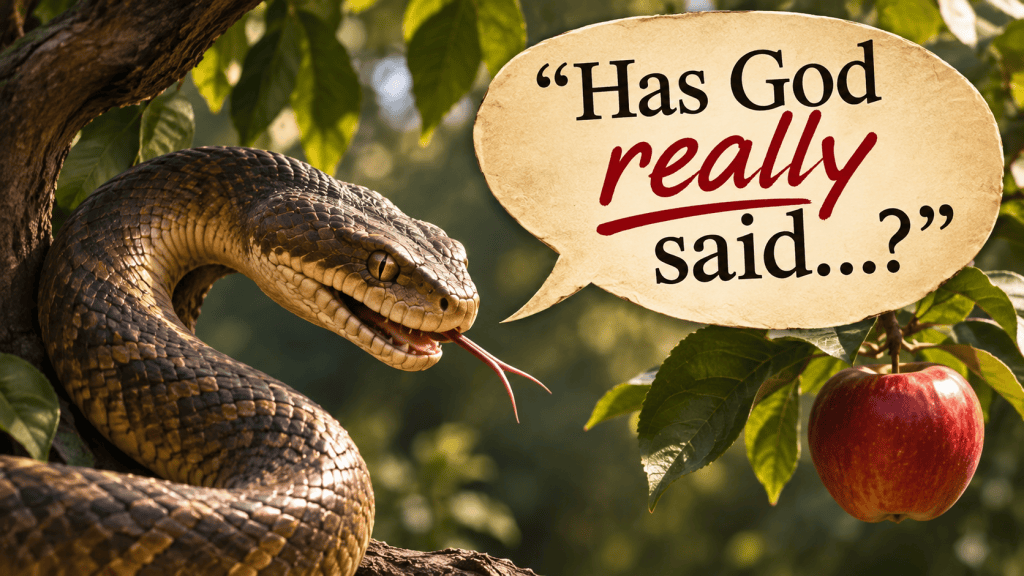
First, question God’s Word.
Then distort it.
Then dismiss it.
Finally, replace it with something that feels better and more comfortable. And then convince yourself that the replacement is Christianity…
Religious Profession Is Not the Same as Saving Faith
Perhaps the most sobering warning Jesus ever delivered to outwardly religious people appears in Matthew 7:21–23.
He described people who would address Him as Lord and point to their religious activity as evidence that they belonged to Him.
Yet Jesus’ response will be utterly devastating:
“I never knew you; depart from Me, you who practice lawlessness.” — Matthew 7:23
These aren’t people who lacked the right spiritual vocabulary. They knew how to say “Lord!” They even proudly proclaimed all the things they had done in His name…
But they did not belong to Him.
This is EXACTLY why we must stop confusing a claim of being a “Christian” with the actual possession of saving faith.
A cross around your neck does not regenerate your heart. A Christian slogan (what I call “witness wear”) on your t-shirt doesn’t reconcile you to God. Nor does your hand raised to the latest Christian anthem….
Church attendance, denominational affiliation, baptism, and religious activity are not a substitute for the new birth (John 3:3-8). And neither can just a mind full of biblical knowledge.
Jesus confronted religious leaders who “diligently searched the Scriptures“: but refused to come to Him for life (John 5:39–40). So the answer isn’t simply to pack as many biblical facts and stories into people’s brains…
We desperately need the life-giving work of the Holy Spirit, who opens blind eyes, brings sinners to repentance and faith, and produces a genuine love for Christ and His truth.
The Word is not an alternative to that work. It is the God-provided and designated means through which the gospel is proclaimed and faith comes by hearing (Romans 10:17).
What Does Your Relationship With God’s Word Reveal?
John addressed this subject with remarkable clarity.
In his first epistle, he warned against claiming fellowship with God while walking in darkness (1 John 1:6).
He warned against claiming to be without sin (1 John 1:8).
And he wrote: “The one who says, ‘I have come to know Him,’ and does not keep His commandments, is a liar, and the truth is not in him.” — 1 John 2:4
They are God’s words.
John wasn’t teaching that genuine believers achieve sinless perfection. He had already specifically rejected that idea and pointed believers to the forgiveness found in Christ (1 John 1:8–2:2).
John’s real concern was the direction and character of a person’s life. Noone would deny that genuine believers still struggle with sin. But a real believer simply cannot make peace with a life of unrepentant rebellion against Christ.
The regenerate Christian grieves over sin, confesses sin, fights sin, and depends continually on the grace of God.
Meanwhile, the unbeliever readily redefines sin until repentance seems unnecessary.
There is an eternal difference between struggling against the sin you hate and demanding that God approve the sin you love. And this distinction ought to humble every single one of us.
This is NOT a license to declare ourselves the final judges of other people’s salvation, because only God knows the heart. But Scripture gives us legitimate grounds to examine our own profession and to call others to do the same (2 Corinthians 13:5).
A Warning to Pastors and Churches
The responsibility for this very real crisis doesn’t just rest on individual Christians. We pastors and churches must take responsibility responsibility as well. Rightly preaching and teaching the Word of God requires effort, takes intentionality, and it requires a great deal of verse-by-verse exposition to keep us from twisting the text.
When pulpits substitute motivational, relative-moralistic speeches for the faithful exposition of Scripture, how can we pretend to be surprised when church members become biblically malnourished?
The troubling practice of measuring church “success” primarily based on attendance numbers, entertainment, emotional experiences, and financial growth, they can passively teach that full biblical understanding is optional.
When difficult, politically or emotionally dangerous doctrines are avoided because they might offend someone, the message becomes clear: Human comfort and feelings are more important than divine truth.
But pastors are not called to be religious entertainers.
They are called to preach the Word (2 Timothy 4:2).
The church is called to make disciples, teaching them to observe all that Christ commanded (Matthew 28:19–20).
The responsibility of a faithful pastor is not to make the Bible say what people want it to say. It is to faithfully explain what God actually said, what He meant, and how His people should respond.
The responsibility of believers is not merely to consume a weekly sermon. It is to receive the Word eagerly, examine what they are taught, and grow in the grace and knowledge of Jesus Christ (Acts 17:11; 2 Peter 3:18).
The Answer Is Not Less Truth, but More of Christ
Some will undoubtedly see the featured image for this post and be offended. Some may see it as grotesquely provocative, meant to stir up trouble.
But my prayer is that some might find it convicting.
Maybe we should ask of ourselves – do I take the Bible seriously? Not just its existence. Not just what our doctrinal statement says about the Bible, but that God’s Word be something we crave as the deer pants for water… (Psalm 42:1)
We have generations of people who have inherited Christian language and ritual without understanding Christian doctrine or even the gospel. We have churches filled with people who know how to go through the motions of “religious activity” but have never seriously examined the gospel.
We have individuals confidently proclaiming what Jesus believes while neglecting the very Scriptures through which His teaching is made known. And, sadly, we have professing Christians who respond to biblical correction not with humility, but with hostility. Who would rather run away than face what God has said.
What’s the answer?
The answer is to return to the Word of God, to recover a proper fear of the Lord, and to proclaim the unchanging gospel of Jesus Christ.
We must call people to repent and believe.
We must teach the FULL counsel of God.
We must show by our actions that truth and love are not enemies.
And we must remember that the goal of biblical teaching and study is not about winning arguments, it’s to point sinners to the Savior and to bring disciples to be more like Christ.
Final Questions:
If you claim to love Jesus, but have no interest in what Jesus has said, what exactly do you actually love?
If you claim to know God but insist that your desires, feelings, or cultural preferences carry greater authority than His revealed Word, which god are you actually serving?
And if you confidently assume that you belong to Christ while deliberately refusing His correction, have you considered that just maybe your confidence is in the wrong place?
Uncomfortable questions? Yep. Not because I take joy in condemning people, but because eternal reality is FAR too important to hide behind niceties.
The gospel does not tell us that we are already good enough or deserving enough… It tells us that we are sinners who desperately need a Savior.
But praise the LORD – the good news is that Jesus Christ, the eternal Son of God, lived in perfect obedience, died as the substitute for sinners, bearing the judgment they deserved, and rose bodily from the grave.
He saves whoever (all) who repent and believe in Him.
No amount of biblical knowledge can earns salvation. At the same time, no amount or severity of sin puts a repentant sinner beyond the sufficiency of His grace.
So open your Bible. Read it. Study it. Ask the hard questions. Seek out faithful teachers, taking advantage of the opportunities laid before you. Test what you hear (and believe) against the Word of God. Be willing to acknowledge that maybe something you have long believed is might be in error.
BUT above all, come to the Christ whom the Scriptures reveal.
Because a dust-covered Bible is a tragedy.
And a lifetime spent proclaiming a Jesus of your own imagination, only to stand before the real Christ and hear, “I never knew you,” is an eternal catastrophe.
The issue is not merely whether you own or have access to the Bible. The real issue is whether you are willing to hear—and submit – to the God who speaks through it.

