

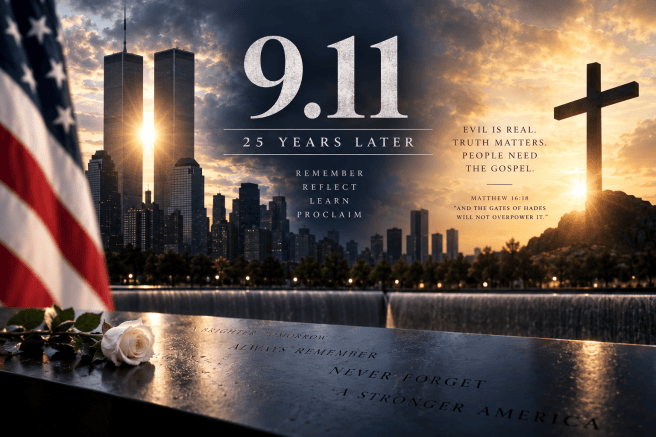
I had just wrapped up my first-period high school band class and was walking into the library building at Carlisle High School in rural east-central Arkansas.
As I came through the doors, headed toward the study hall room I supervised during second period, I was met by Ms. Vanessa Hall, our library media specialist. She could barely speak.
Something about the news.
An airplane had hit the World Trade Center.
She asked me to quickly pull a television from the back and connect the cable so we could see what was happening. I had barely gotten the television connected and turned on when we watched the footage of the second plane striking the South Tower.
Like so many other Americans, I simply stood there, transfixed.
How could this be?
Who would do such a thing?
My mind immediately went to the people inside those buildings. The passengers aboard the airplanes. The people desperately trying to escape. The families who had no idea yet that their lives had just changed forever.
Then came the news that American Airlines Flight 77 had struck the Pentagon.
That was when it became unmistakably clear: this was not some horrific accident. The United States was under direct attack on a scale almost incomprehensible to me.
Then came Flight 93, crashing into a field in Pennsylvania after passengers and crew fought back against the hijackers.
By that point, I was emotionally and mentally wrecked.
And then the explanations began.
Within days, President George W. Bush stood at the Islamic Center of Washington and declared, “Islam is the religion of peace.” His purpose was understandable. The administration was trying to prevent retaliatory violence against all Muslims, and to make clear that America was not declaring war on every Muslim in the world, but his words completely avoided the question than needed to be asked: What role did Islamic theology and Islamist ideology actually play in the terrorism we had just witnessed?
Islamist terrorism was certainly not new on September 11. Hijackings, embassy bombings, the bombing of the USS Cole, and the destruction of Pan Am Flight 103 over Lockerbie, Scotland, had already demonstrated the threat posed by violent Islamist movements.
Surely, after September 11, we would learn something.
In the immediate aftermath, Americans began asking serious questions.
Church attendance temporarily surged as people searched for comfort, meaning, and answers. Questions were raised about failures within American intelligence and law enforcement. Those concerns were not imaginary. The 9/11 Commission later documented numerous missed opportunities, including failures to properly watch-list future hijackers, failures to share intelligence between agencies, and failures to connect suspicious flight training and other warning signs with the growing threat.
Security changed almost overnight.
The Transportation Security Administration was created. Airport screening expanded dramatically. Identification requirements increased. Cockpit security changed. Americans became accustomed to long lines, shoe removal, baggage restrictions, and limits on what could be carried onto an airplane.
Some of those measures unquestionably addressed real vulnerabilities. Others have rightly been questioned for their effectiveness, and government reviews over the years have continued to identify weaknesses in aviation screening and testing.
Congress conducted hearings. Intelligence agencies were pressured to communicate with one another more effectively.
Then came war.
The United States entered Afghanistan in October 2001, targeting al-Qaeda and the Taliban regime that had provided it sanctuary. The war in Iraq followed in 2003. Afghanistan would become America’s longest war. Thousands of American service members would die, many thousands more would be wounded, and an enormous number of Afghan and Iraqi civilians would also suffer and die through the decades of war that followed.
Surely, after all of that, we would learn something.
Yet here we are, twenty-five years later and what exactly do we have to show for it?

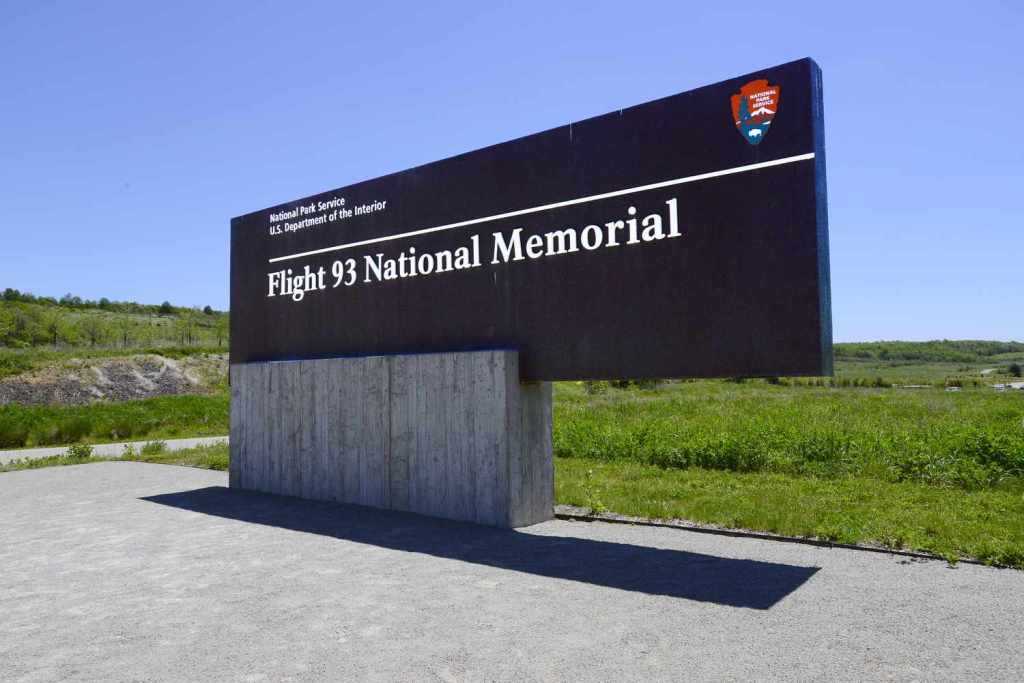
We have a memorial at Ground Zero. We have a national memorial in Pennsylvania for Flight 93. We still have the TSA (though many tests have shown questionable effectiveness).
We have documentaries, investigations, books, commemorations, arguments, and enough conspiracy theories to fill libraries—some so detached from credible evidence that they ultimately distract from the very real evil that took 2,977 innocent lives that day.
On a more local level, many cities across America are seeing an explosion of Islamic Centers and Mosques being built, not so much due to mass conversions, but because of the massive immigration of adherents of Islam. Entire cities have become functionally Muslim-run, with even hints of Sharia Law courts.
We have a previous President who, while claiming to be a Christian, directly aided, armed, and promoted the “Arab Spring” revolutions across North Africa and the Middle East, further solidifying more radical Muslim governments.
But have we actually learned the most important lessons?
The cultural conversation surrounding Islam remains extraordinarily confused.
President Bush’s formulation that “Islam is the Religion of Peace©” became part of a much broader tendency to avoid serious discussion of the theological and historical claims of Islam for fear that criticism of a religion will automatically be interpreted as hatred toward the people who practice it.
Those are not the same thing.
A Christian can love a Muslim neighbor, defend his civil rights, protect him from violence, invite him into his home, feed him, help him, and gladly treat him with dignity as someone made in the image of God— while still believing that Islam is false.
Islam explicitly rejects truths that stand at the center of Christianity: the divine Sonship of Jesus Christ, the Trinity, the crucifixion as Christians understand it, and therefore the substitutionary death and resurrection of Christ as the only ground of reconciliation with God.
These are not minor doctrinal disagreements.
They concern the very identity of Jesus Christ and the nature of salvation.
Meanwhile, the Muslim population and political influence of Muslim communities have increased throughout much of the Western world. New York City—the city that suffered the greatest loss of life on September 11—now has its first Muslim mayor, Zohran Mamdani, who took office January 1, 2026, and who counts among his closest friends and advisors, members of the Muslim Brotherhood (a terror-linked international organization).
Again: Did we learn anything?
Because my greatest concern twenty-five years after September 11 is actually not Washington DC.
It is not immigration policy.
It is not airport security.
It is not even Islam.
My greatest concern is Christ’s Church.
Among those of us who profess Christ, we have increasingly fallen into disarray.
Instead of standing firmly on the truth, we too often retreat.
Instead of allowing the spiritual realities before us to motivate us to proclaim the life-giving, reconciling gospel of Jesus Christ, we circle the wagons.
We worry. We complain. We argue online.
We become consumed with elections, governments, movements, personalities, and political power.
In some corners, Christianity has become so entangled with nationalism, dominionism, or political identity that protecting “Christian America” seems to receive more energy than proclaiming Christ to lost Americans.
That is a tragic, even catastrophic flipping of priorities.
Jesus never commissioned His church to conquer the world through elections.
He told us to make disciples.
And when Jesus declared that He would build His church and “the gates of Hades will not overpower it” (Matthew 16:18), the imagery should at least cause us to reconsider the posture we have adopted.
Gates are defensive structures.
The Church of Jesus Christ was never intended to spend its existence hiding behind barricades, terrified that the world might overwhelm it.
Christ builds His church. Christ saves sinners. Christ changes hearts.
And Jesus Christ destroys strongholds through the proclamation of His truth.
And Jesus has clearly commanded His people to go…
Yet while Islam grows in various parts of the world, and alarmingly so here in Texas, Christians fight among themselves.
While millions need the gospel, professing believers “deconstruct.”
While error is proclaimed boldly, blasphemes by so-called Christian ministers turned US Senate candidates, many Christians whisper the truth as if we have something to be ashamed of…
While our culture desperately needs Christians who live lives of holiness, integrity, courage, compassion, and unfailing confidence in God’s Word, we are far too often better known for outrage than hope.
Maybe that is the lesson we still haven’t learned.
September 11 proved beyond a shadow of doubt, again, that evil is real. It reminded us that ideas have consequences.
But for those of us who pay attention, it also demonstrated that theology matters.
It demonstrated that our civilization is not immune from violence, hatred, fanaticism, or collapse.
But for Christians, it should have reminded us of something far greater:
Our hope has never rested in the security of the United States of America. Our hope doesn’t rest in alphabet intelligence agencies.
It can’t rest in political parties.
It certainly doesn’t find peace in electing enough of the “right” people.
Our hope rests in Jesus Christ. Period
And the answer to false religion, even death-cults, is not fear. It is truth.
The answer to Islam is not hatred of Muslims, it is the gospel of Jesus Christ proclaimed to Muslims.
The answer to a collapsing culture is not merely recovering political power.
It is Christians faithfully being Christians.
Standing on Christ Jesus as our foundation.
We must speak the truth without apology, finding ways to love our neighbors without compromising that truth.
We simply must seek to live lives of genuine holiness and integrity.
WE must reject calling evil good or good evil.
And we must preach Christ crucified and risen., making disciples, taking the gospel across the street and across the world.
THAT is how the Church advances.
Just maybe that should have been one of the deepest lessons Christians carried away from September 11, 2001.
Twenty-five years later, the uncomfortable question is:
Have we forgotten?

