

Taking a quick pause from packing boxes to grab some lunch and breathe for a minute, a thought hit me:
What’s in a church name?
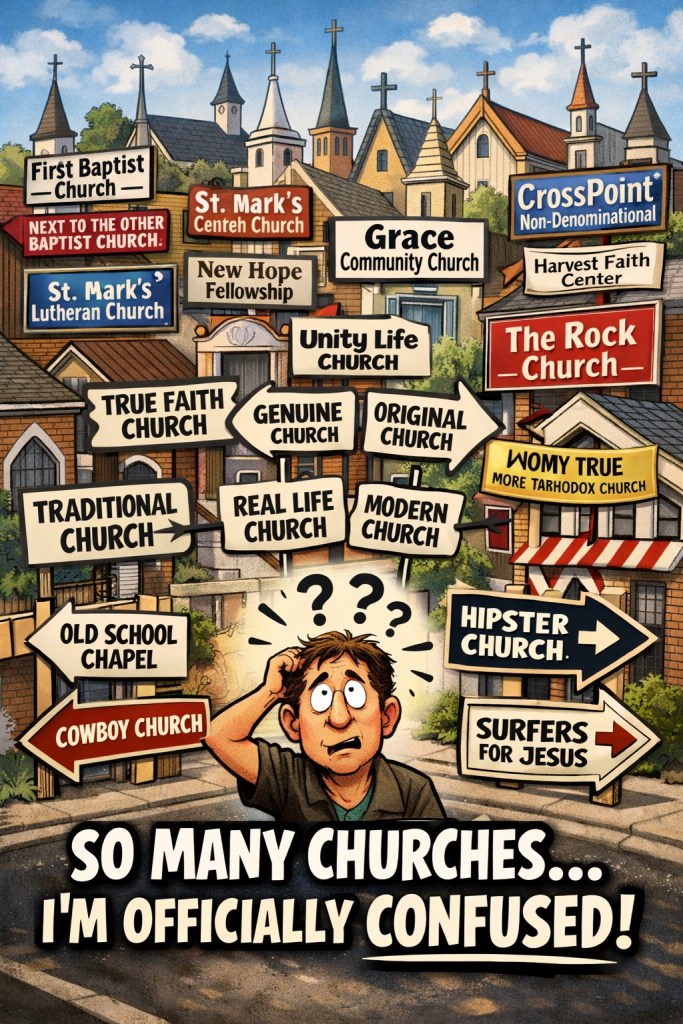
Not that long ago, you could drive past a church building and have a pretty fair idea of what was believed and taught simply by reading the sign.
- Catholic (Roman, Eastern, Greek, Russian, Ukrainian Orthodox, etc.)
- Methodist (Wesleyan, United, etc.)
- Baptist (Primitive, SBC, ABA, Landmark, Free Will, and so on)
- Presbyterian
- Lutheran
- Church of Christ
- Disciples of Christ / Christian Church
- Pentecostal (many forms)
- Assembly of God
- Foursquare …you get the idea.
Most folks didn’t know every doctrinal nuance, but they could at least make an educated guess about what distinguished one from another.
Then came the fog bank known as “non-denominationalism.”
Now, before anyone sharpens their pitchforks, I understand the desire to distance from bureaucracy, decline, or denominational politics. But let’s be honest: in many cases, the label “non-denominational” feels less like clarity and more like camouflage. From what I’ve seen, most churches using the term tend to fall into a few broad categories:
- Baptist (but without the perceived baggage of the name)
- Methodist (especially in light of recent departures from the UMC)
- Pentecostal / Assembly-of-God–like
- Trulyruly “non-denominational” — often meaning they lack defined doctrinal boundaries altogether, all the way to the extreme of unitarian/univesalists (which is a “denomination”).
A growing phenomenon seems to be the pop-up hybrid church: 95% Baptist in theology with a 5% charismatic accent (or some mix thereof). To complicate matters further, I know churches that are more historically Baptist in doctrine, confession, and practice than many churches still wearing the Baptist name.
Then there are congregations shaped by one theological tradition but practicing a different ecclesiology:
Baptist theology with elder-led, Presbyterian-style governance, Methodist theology with congregational/Baptist polity, and countless other blends. And just when you think you’ve mapped the terrain, you discover a celebrity megachurch that looks nothing like the denomination it’s technically affiliated with. 🤷🏽♂️
At some point, it all begins to feel less like clarity and more like confusion.
So here’s my plea:
Let’s be honest.
If a historic label fits, don’t run from it.
If it doesn’t, that’s fine — but clearly state what you believe.
Clarity builds trust.
Ambiguity breeds suspicion.
And if the goal is to reach people rather than trick them, then transparency isn’t a liability — it’s a virtue.
 Contending For Christ