

Loss of salvation or scribes guilty of the offense addressed?
In my morning musings and reading, I came upon Revelation 22, and verse 19 in particular. Every time I read this passage, I think back to many arguments over theology, with the key doctrine of “Eternal Security of the Believer”. Over the years, I have heard this particular verse used in many ways that simply are abuses of not only the immediate text itself, but fly in the face of consistent biblical doctrines. But what struck me this morning as I again mulled over this passage, was the wild (or not) idea that the very scribes tasked with duplicating manuscripts might very well have been guilty of the offense the verse addresses.
But lets break this down in a couple of ways:
The Doctrine
The doctrine of Eternal Security of the Believer is an often maligned and abused point. On one hand, we have those who’s application of the doctrine pushes the threshold of Paul’s condemnation of those who “continue in sin so that grace may increase” (Romans 6:1), who by their actions reveal that they are still lost in their sin. On the other hand, we have those who believe that even a genuine believer can loose their salvation with as little as a single sin that has not be explicitly repented of (yes, to the extreme of having a sinful dream and dying before you wake to repent!). This latter group tends to use Romans 22:19 as a club to bash anyone who lays claim to “once-saved, always-saved” (the more misunderstood version of Eternal Security of the Believer (or among more “Reformed brethren”, Perseverance of the Saints).
This doctrine is based on a consistent hermeneutical approach to Scripture interpreting Scripture, where no contradictions can exist. But the most compelling of all are Jesus’ own words in various statements. A few examples:
- and I give eternal life to them, and they will never perish—ever; and no one will snatch them out of My hand. My Father, who has given them to Me, is greater than all; and no one is able to snatch them out of the Father’s hand. John 10:28-29
- All that the Father gives Me will come to Me, and the one who comes to Me I will never cast out….Now this is the will of Him who sent Me, that of all that He has given Me I lose nothing, but raise it up on the last day. John 6:37 & 39
Elsewhere in the New Testament, we find numerous other references to the irrevocable nature of salvation:
- Romans 8:30 “…those whom He predestined, He also called; and those whom He called, He also justified; and those whom He justified, He also glorified.”
- Ephesians 1:13 “In Him, you also, after listening to the word of truth, the gospel of your salvation—having also believed, you were sealed in Him with the Holy Spirit of promise”
And indeed, John wrote in 1 John 2:19, “They went out from us, but they were not really of us; for if they were of us, they would have remained with us; but they went out, so that it would be manifested that they all are not of us.”, indicating that they were never regenerate believers in the first place, not that they had somehow lost their salvation.
Indeed, Dr. John MacArthur famously stated “if you could lose your salvation, you would.”
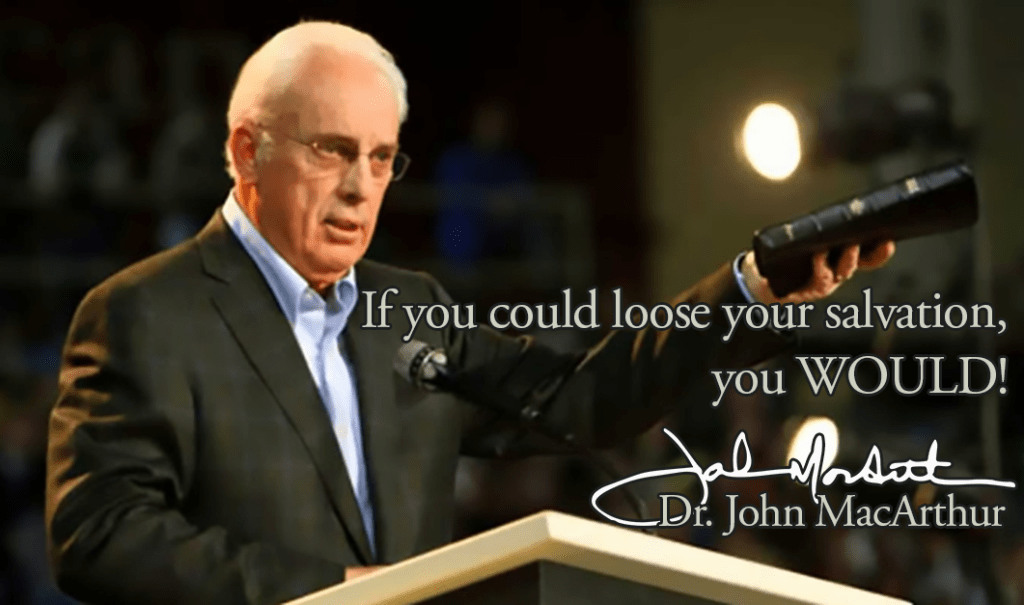
But this post isn’t so much about this precious and critical doctrine, but about the text itself and how it is not only abused, but contains a possibly ironic twist.
The Text
And if anyone takes away from the words of the book of this prophecy, God will take away his part from the tree of life and from the holy city, which are written in this book. Revelation 22:19 LSB
But it is better known by many in the King James Version:
And if any man shall take away from the words of the book of this prophecy, God shall take away his part out of the book of life, and out of the holy city, and from the things which are written in this book. (KJV)
In short, this text is a caution against altering the prophecies contained in THIS book – aka Revelation. It is referencing all the prophecies that were revealed to John and that the apostle was instructed to record. While there may be an application possible to the entirety of the Bible, that isn’t the explicit context of this warning. God was warning those who might try to bend or twist the prophecies, thus ruining their testimony.
But the question then arises, what is the Lord warning is the consequence of taking away from the text (generally understood as changing/altering the text)? The older translations, particularly those primarily based on the Textus Receptus (such as the KJV) state that the offender’s “part” will be taken out of the “book of life, and out of the holy city, and from the things which are written in this book.”
There are two major manuscript variants:
- Some later manuscripts read “book of life” (βίβλου τῆς ζωῆς). (KJV/Textus Receptus)
- The earliest and best manuscripts (including Aleph [Sinaiticus] and A [Alexandrinus]) read “tree of life” (ξύλου τῆς ζωῆς). (most contemporary translations based on the Critical texts)
- Book of Life: Likely a scribal harmonization with Revelation 3:5 and 20:12, where the “book of life” is explicitly mentioned.
- Tree of Life: Fits the immediate context of Revelation 22, where “tree of life” is the repeated focus (vv. 2, 14).
The strongest textual evidence supports “tree of life” rather than “book of life” in Revelation 22:19.
Implication
The word for “part” (μέρος) can mean portion, share, inheritance.
Having a share in the tree of life and the holy city is a figurative way of describing the right to eternal life and citizenship in God’s kingdom.
The text says:
“If anyone takes away…”
This is a general warning, not directed at believers per se, but to any person who distorts, subtracts from, or manipulates the words of this prophecy.
It mirrors the severe warnings of Deuteronomy 4:2 and 12:32 against adding to or taking away from God’s word.
The person in view is one who, by their deliberate distortion of Scripture, evidences themselves to be false or outside the community of the redeemed.
- The correct textual reading is “tree of life,” not “book of life.”
- The warning is directed toward anyone who distorts or corrupts Scripture.
- Having a share in the tree of life represents a right to eternal life.
- Perseverance of the saints remains intact: true believers will never fall into this category, as they are guarded by God.
- The person whose part is taken away never truly possessed eternal life — their tampering with God’s Word reveals their unregenerate condition.
This warning is not about losing salvation, but rather about the eternal judgment upon those who treat God’s Word with disdain or pervert it.
The Irony
If later scribes intentionally altered the wording of Revelation 22:19 to harmonize it with Revelation 3:5 by changing “tree of life” to “book of life,” that would, ironically, be a textual example of doing exactly what this verse warns against: tampering with the words of the prophecy.
Here’s the careful distinction:
- If the change was accidental (which does happen frequently in manuscript transmission), the scribe would not be personally culpable in the same way the passage warns.
- But if the alteration was deliberate, with the goal of forcing a theological harmony or inserting a preferred interpretation, it would directly fall under the kind of manipulation this passage condemns.
Later scribes who may have added or adjusted words to “protect” a theological point may have, in fact, committed the very act the verse forbids: adding to or taking away from the inspired text.
This would have been:
This would have been:
- Unintentional but still corrupting (if they thought they were “helping” the text).
- Theologically dangerous (if they were knowingly altering Scripture to fit doctrinal preferences).
 Contending For Christ